
Is selling your trip's treasures a viable way to afford another trip?
 I was thumbing through the backlog of vagablogging.net entries to make sure I didn't post about something someone else had already covered when I stumbled across Aaron Hotfelder's post asking what sort of mementos and keepsakes people like to bring back from their trips.
The comments on that piece generated responses like passport stamps, Christmas ornaments and other small items (good readers, traveling light), but the topic reminded me of a woman I met in India.
By all outward appearances she was a typical vagabond — traveling for an extended period of time, friendly, inquisitive, curious and astute at finding out of the way sights and fascinating small towns (which is why I tagged along with her for a few days).
But then the morning she left, I saw her emerge from her hostel carrying an enormous backpack and pulling a huge wheeled suitcase. We ate breakfast before her train left and I couldn't help asking what was up with luggage. Oh, she said, this isn't even half of it; the rest is back in Delhi. It turned out that inside the wheeled suitcase was another smaller wheeled suitcase and several duffel bags nested like Russian dolls.
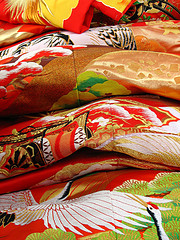
She told me how she spent six months every year traveling around India, Pakistan, Iran and other fabric-rich countries buying cloth. The other six months out of the year she spent in London selling it all on E-Bay, which in turn paid for the next trip (and then some I imagine).
At the time I thought, brilliant, using your travels to earn money for more travel, what could be better? But now I can't help thinking that perhaps it's a little exploitive. Not to pick on her example, but doesn't it basically boil down to exploiting cheap labor/goods to turn a profit, just like a giant international distributor?
I've met others since that first trip — a man shipping cheap wicker furniture out of Thailand for sale in the States, another man in Nicaragua who scoured the country for Colonial-era antiques and sold them at a store in Arizona, and so on.
The common thread between them is that the income the items generated was a means to continue traveling. On the surface it seems like a viable choice for a vagabond. But then again, I'm not so sure.
What do you think? Is it exploitation? Is it helpful because it dumps at least some money in the local economy? Is it a viable/sustainable way to keep traveling?
2008-08-12 14:10
I'm not sure that I see the difference. What is the difference if she resells the stuff or actually makes use of it? The local vendor
is probably getting a fairer price than with a giant international distributer. Would it be more ethical of her to help them setup computers, internet access, and an eBay account so they can sell the stuff on eBay themselves?
2008-08-12 14:54
I figure, it's not exploitation because these folks are trying to sell these things, and she's buying them. I think a fabric vendor would be a lot more happy with someone buying stacks of their stuff rather than one or two. They're probably rather happy about the whole thing.
The only thing I wonder about is if she's really getting the most out of her travels doing it this way. If she's constantly focused on buying and selling, I imagine that could get in the way of some awesome experiences. But, maybe she has a good balance of how she uses her time, and if that's the case, then she's pretty smart.
2008-08-12 18:57
The miracle of voluntary exchange is that it leaves both parties better off. Imagine if a hundred or a thousand people did exactly what this woman is doing: would the vendors be better off, or worse? Better, since they'd have a larger market for their goods, and would be able to charge a higher price. Too often travelers see exploitation where what really exists is just voluntary exchange.
2008-08-14 15:18
Scott, have you ever come across anyone who has done this with US travel instead of international travel?
I imagine you'd have to have a really good eye for light-weight, non-fragile, re-sellable items.