
Complete guide for American expats returning home
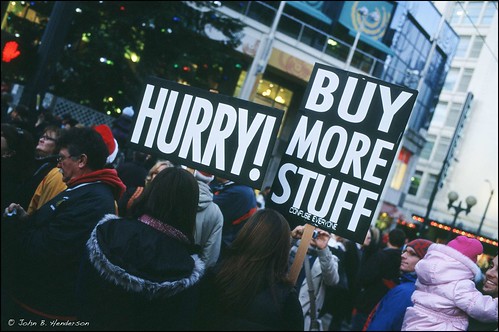
Activists in Seattle mocking Black Friday sales. Photo: John Henderson / Flickr
Have you ever returned home, only to feel like home was more foreign than any of the exotic locales you’ve visited? You’re not alone. Reverse culture shock has a way of ambushing people, despite how much you may have heard about it. When we travel, we have our awareness up. We know we must learn and adapt. But home? We let our guard down. We don’t have to think too hard, because we’re back on familiar ground. Or so we think.
CNNGO published the Ultimate checklist for returning U.S. expats. The article covers a wide range of topics, ranging from practical matters like money to more social niceties like pop culture. The writer is mostly tongue-in-cheek in tone, particularly the section on what’s hot and what’s not these days.
More sobering is the final section on reverse culture shock. Every one of the points resonated with me. Here’s one excerpt:
Nobody cares where you’ve been
People outside the U.S. often like to hear what life is like there. Americans, owing to either a sense of superiority or disinterest, aren’t all that curious about what’s going on in Mamalikibooboostan.
This is why our Rolf Potts in Vagabonding emphasized that travel should be a personal decision, not to prove something to others. No one will care as much about your travels as you do.
I returned to the United States after five years of working and traveling in Asia. Like many, I was blindsided by the process of re-adapting. Here are some ways I’ve dealt with culture shock:
1) Use Skype. I still regularly chat with some of the close friends I’ve made while on the road. Talking to people with the same shared experiences has been a huge morale boost.
2) Make new friends. I’ve been active on Meetup.com, joining groups that match my interests.
3) Attend travel meetups. Events like Meet Plan Go and Couchsurfing meetups are great ways to meet travelers where you live.
Did you experience reverse culture shock when you returned home? Where had you been living and traveling before then? What did you do to cope? Please share your stories in the comments.
February 24th, 2012 at 3:41 pm
Wow I am glad I read this article now. I never really thought of this. I will be returning home in about six months and only remember all the things I left. Not even considering that life did go on in my absence. I will have to consider this blog when I get home so as I do not lose myself. With that said I hope that I can keep some parts of myself that I gained living in a third world country. The need to not over indulge and uselessly spend money, is one that I hope to carry with me. Thanks for you post and for the heads up.
August 1st, 2012 at 8:26 pm
The comments were as helpful as the writeup. Like HP, I’ve got several months before my return to the US. My problem: how the hell do I search for jobs? I’d been independent since 2004 before taking a job this year at a university. Where do I start to look, where do I want to live?
Cheers to all others repatriating to the US.
@NicholeLReber
March 21st, 2013 at 12:02 am
I am considering returning to the U.S. after nine years abroad in Asia. After speaking to a recently returned expat friend I find the article and list sadly lacking in real usable data. My friend found that his credit score had suffered simply because he had lived abroad for years not using credit, which not only affected direct credit availability, but other things such as auto insurance. In fact, auto insurance was a double whammy with a spike in rates because of a poor credit rating as well as a three to five year huge rates penalty due to no U.S. insurance record for the past few years.